If you’ve been paying attention at all, you’ve seen articles with increasingly horrifying information about how much our world is swimming in pollution, PFAS, chemicals of all kinds, and in particular, microplastics (and nanoplastics). We now have a plastic spoon’s worth in our brains and that’s up 50% in the last eight years, rising with increasing plastic in the environment: “On average, microplastic levels were about 50% higher in brain samples from 2024 than in 2016 samples.”
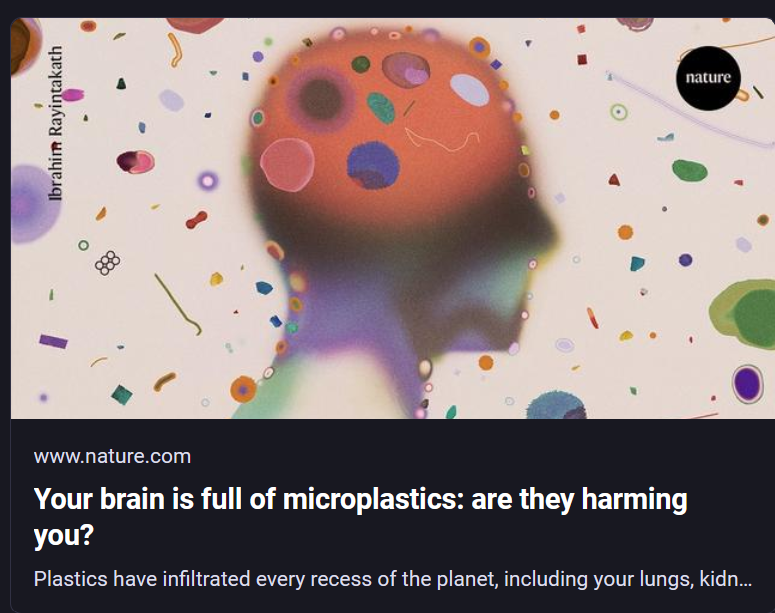
There’s zero chance this is good for us—it’s just a matter of how bad and how fast it will become much worse.
“nearly 60% of about 250 people who were undergoing heart surgery had micro- or nanoplastics in a main artery. Those who did were 4.5 times more likely to experience a heart attack, a stroke or death…”
I literally wrote a story about the future of microplastics and you should probably go read that right now (it’s free): https://reckoning.press/its-in-the-blood/
How to Reduce Your Exposure
This blog post isn’t to get you to read my fiction, however (although you should!)—it’s to collect up all my strategies for reducing your exposure to plastics because I’ve been posting about this fairly frequently and it’s just easier to have it all in one place.
Isn’t It Pointless? Microplastics Are Everywhere!
I see folks taking a *shrug* what can you do?? approach to microplastics and I’m begging you not to do that. I swear, it’s some kind of modern mental glitch that we hear about something bad and assume that absolutely nothing can be done about it… and 1) that’s 100% false and 2) exactly what the fossil fuel companies would like you to think.
IMPORTANT: It’s not your imagination that plastic is fucking everywhere… and there’s a very simple reason: it’s what the fossil fuel industry has been tirelessly trying to make happen, convincing every company to shove more plastic into everything. And they’re planning to INCREASE the amount of plastics in our lives MORE (because they fear reduced fossil fuel usage due to solar and EVs) with plans to *triple* plastics use by 2050.
Triple.
Not content with destroying the Earth with greenhouse gasses, these MFers want to fill our brains with microplastics too. The mental gymnastics required to do this shit when you presumably have a brain of your own that you would prefer not to be filled with microplastics is just astonishing. Then again, maybe the microplastics have already colonized Fossil Fuel CEOs brains… but that’s really too generous.
It’s just greed that’s made their brains malfunction.
What You Can Do To Reduce the Threat of Plastics
First of all, just understand that this is a real thing that’s crazy dangerous and we should be reducing all pollution everywhere, but microplastics and pesticides and the chemical soup of our lives is a real thing that is having adverse health effects across the planet.
So vote/advocate for reducing plastics everywhere you can.
Meanwhile, take some defensive actions to reduce your exposure.
(The science is unclear on a lot of this. I’d like to say “research is ongoing” but Republicans in America are trying super hard to kill all science research, especially anything related to health, so who knows if we’ll get more good science on this. For now, it’s not clear how much of these microplastics accumulate in the body, or where, or what the impact of that is—the body has some natural mechanisms to clear out foreign materials, but not an infinite amount. And it’s certainly not designed to live in a microplastic soup. But it is possible that there are some clearance mechanisms, so if you reduce your exposure, you could reduce the amount in your body over time. If not, then it’s an even better idea to reduce exposure because this stuff might be accumulating.)
“Some have built up in the environment over many years, while others arrive daily, as they shed from tires, our clothing, food packaging, personal care products and more.” —NPR article from Dec 2024 with lots of excellent information (see references below)
Here’s my personal list of things that I’ve done (or am trying to do). References below for you to peruse and come up with your own strategies. I’m not the microplastics police (I wish!). I’m just trying to give you some simple defensive measures. They’re not zero cost but then neither is accumulating microplastics in your blood. For sure, the best is to reduce how much new plastic we make each year, but even if that went to zero overnight, there is still a ton of plastic in the world that will be circulating for decades.
- filter your water
- don’t store anything in plastic (use glass or metal containers)
- take food out of to-go containers as soon as you get home and eat off plates (better yet, cook at home)
- dust with microfiber and vacuum regularly with HEPA filter vacuums (microplastics shed from furniture and carpet; reducing the amount of dust in the house will reduce your accidental ingestion)
- cut open tea bags and use a stainless steel infuser (tea bags have glue and plastics infused in the bags) — even better, get organic loose-leaf tea
- don’t use single-use plastic anything that you can avoid, but especially drinks/water (and double especially if it’s for hot beverages like coffee/tea, those “paper” cups have plastic linings)
- don’t use plastic cups/plates
- use cloth reusable grocery bags (use reusable produce bags)
- shop at the food co-op where you can use muslin bags for bulk foods to reduce plastic-packaging
- avoid plastic packaging whenever possible: use powder detergents, shampoo bars, refillable glass sprayers and dispensers for liquids and lotions.
- get your produce from a farm share that doesn’t use plastic containers/bags
- take produce out of plastic bags (wash off pesticides even if organic) and store in fridge in paper or non-plastic containers
- get rid of your black plastic utensils and use bamboo or stainless steel utensils and cutting boards
- probably best to use plastic cutting boards for meat for safety reasons (or better, don’t eat or reduce meat/seafood consumption—microplastics accumulate the further you go up the food chain, so meat has more microplastics than veggies)
- bring your own cup for to-go coffee/tea
- for the love of your body, never reheat anything in plastic in the microwave
- avoid takeout wrappers for food (I literally take the food out of the wrapper and use a paper napkin—it’s basically PFAS and sheds microplastics into your food)—better yet, reduce how much you eat out
- monitor indoor air quality, use air purifiers (put a HEPA-quality filter on your furnace), open the windows regularly
- reduce the amount of processed food you eat (processing introduces microplastics along with additives, preservatives, things that aren’t actually food)
- buy clothes with fewer synthetic fibers/plastics
- keep reusable stainless steel utensils and straws in your car/bag for eating on the go
- Don’t use (and especially don’t re-use) single-use plastics (cutlery, containers, water bottles, storage containers).
- reduce use of food that comes in metal cans (because of the plastic lining)
- don’t put plastic in the dishwasher (it sheds microplastics onto your dishes and into the water, especially because the water is hot)
If I think of any more, or someone offers up a brilliant suggestion I haven’t thought of, I’ll add it to the list. We can help each other out with our strategies because, for sure, the fossil fuel industry is barreling ahead (and sabotaging the global plastics treaty folks are trying to create), so you need to do what you can to protect yourself.
I would love for the world to wake up and stop dumping poison literally into our bodies, but that’s not happening any time soon, and even if it did, the amount of poisons already out there is a lot. That’s not a reason to throw up your hands and give up: it’s a reason to implement some small changes, one at a time, to reduce your exposure. It took me years to come up with that list. I’m sure I’ll be adding more to it going forward. Don’t make yourself crazy with it, just keep making small changes and you’ll be surprised how automatic some of this stuff becomes.
Stay safe, my friends.
References:
https://www.cnn.com/2025/02/03/health/plastics-inside-human-brain-wellness/index.html
https://www.ecowatch.com/avoid-microplastics-at-home-2655282616.html
https://www.ewg.org/news-insights/news/2024/11/top-5-ways-reduce-your-microplastic-exposure
https://www.ucsf.edu/news/2024/02/427161/h
https://www.washingtonpost.com/wellness/2024/05/13/plastics-food-water-safety-contamination
https://www.washingtonpost.com/climate-solutions/2024/12/01/single-use-plastics-reuse-risk/
https://link.springer.com/article/10.1007/s11356-023-25433-7