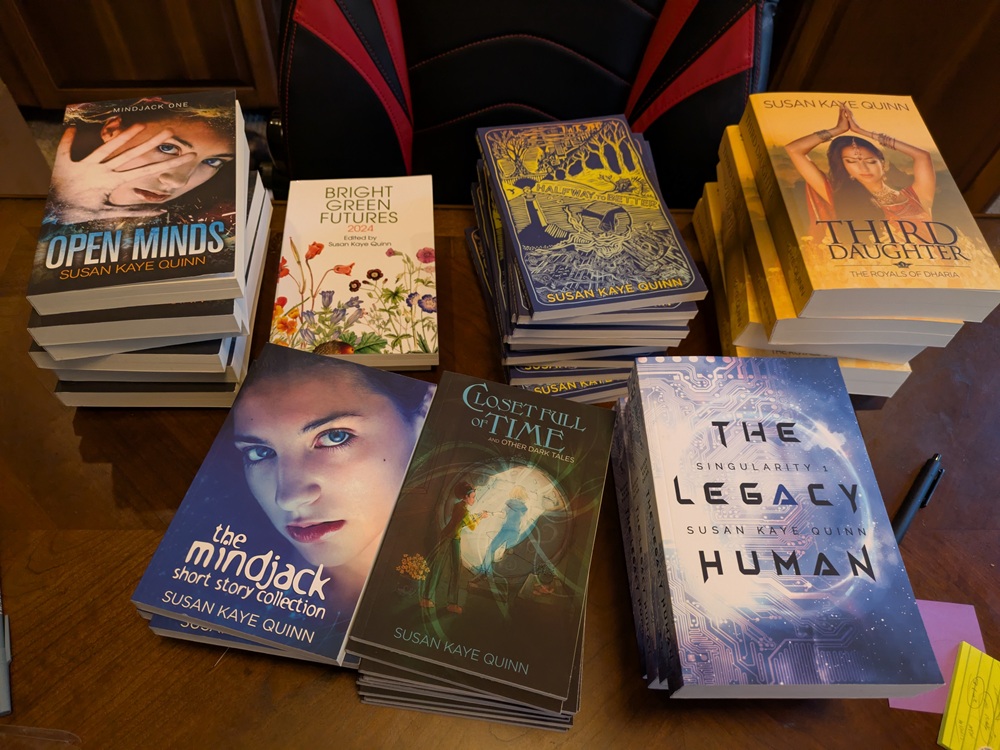
Once upon a time, I was retailer agnostic: I didn’t care where you got my books. I distributed them widely and didn’t have any preference where in the literary ecosystem you bought my books.
But now the literary ecosystem is under attack.
And I definitely care where you get my books because some of the retailers (like Amazon) are actively destroying democracy and shadow-banning the books the fascists don’t like, while other retailers (like Bookshop.org) are actively supporting indie bookstores (which are flourishing and building community along the way). And libraries, all along, have been vital community and literary resources.
Bookstores become community hubs handing out supplies during wildfire evacuations. Libraries make knowledge and the arts accessible to everyone (prefiguring a solarpunk future). Meanwhile, mega tech corporations are literally stealing my books for AI and enshittifying the entire world.
THESE ARE NOT THE SAME
A GUIDE TO BUYING BOOKS
So here’s quick guide on the best (read: most ethical and better-world-building) ways to buy (and borrow!) my books.
Ebooks
Bookshop.org Bookshop is my favorite new thing in books: an online retailer with the convenience of Amazon, except a portion of all sales (ebook or print) go to support local bookstores! And you get to choose which bookstore! It’s a fantastic model, and they just recently started carrying ebooks. You can download their app to your phone or tablet and read there or read on your browser. This is my #1 choice for ebook buying!
Kobo This Canadian company has long been the scrappy underdog on the ebook scene. Yes, they’re owned by Rakuten now and yet somehow they’ve remained largely not enshittified by that. I think it’s the Canadians at the helm! My next ereader will be a Kobo. They have a Kobo Plus program that’s similar to Kindle Unlimited (but not requiring authors to be exclusive), and they’ve long had a way for self-published authors like myself to distribute our ebooks to Overdrive (Libby) so we can get into libraries, which I super appreciate! And they host audiobooks as well! They’re my second choice if Bookshop doesn’t work for you.

Nook Barnes & Noble has the original sin of killing smaller bookstores, but now that those are on the rise again, I can forgive them. Especially because they retained their character as a bookstore (despite those aisles of toys!) and provide a good alternative to Amazon. I still own a (non-functioning) First Edition Nook! But mainly, they’re still a physical bookstore and an important part of the literary ecosystem. They’re my third choice to support with ebook buying.
Libby ebooks (and Your Library)! I’ve always been a huge fan of the library, but even more now, as library economies are manifesting what a solarpunk future looks like today and they’re providing vital community hubs. And they’re under increasing attacks with defunding by the fascists and attempts at book bans. Support your library! And one of the best ways you can do that is to use your library. Circulation helps them get more funding, they pay for the books (even though you don’t) which supports authors, and they’re a great way for authors to get discovered. And you can make requests! The Libby app lets you order ebooks and audiobooks without ever leaving your house: CLICK HERE TO LEARN MORE The library is always a good choice.
All the rest: Amazon, Apple, Google Play — you can find my ebooks there, if those are your preferred retailers (even here, I would prefer you get them from Apple or Google Play over Amazon just to break the monopoly). All of the retailers have apps you can download and read on any device, so there’s really no reason not to move (although I get the preference to read with e-ink, I have an e-ink reader myself).
Audiobooks
Most of my books are on audio, and I know how popular this format continues to be. Which is why I’m so excited about…
Libro.fm This is the Bookshop of audiobooks, with a portion of each sale going to your local bookstore! They also have a membership program that’s a lot like Audible (Audible is owned by Amazon). This is my #1 choice for audiobook buying! But I know audiobooks are expensive (to make and to consume! and if you can afford to pay for audiobooks, that’s important, because someone needs to pay human narrators to use all their talents to make this format available and not have shitty AI audio narrators put them all out of work). Which is why my next preference is…
Libby audiobooks (and Your Library)! The library is always a good choice. And I distribute my audiobooks to Overdrive, so they should be available to your library, but you may need to make a request (it’s easy, promise!): CLICK HERE TO LEARN MORE

Chirp Chirp is operated by the people at Bookbub, which I feel is one of the more-ethical ways to advertise books. They have a newsletter you can subscribe to in order to find out about sales on books. I use Bookbub a lot to reach new readers and increasingly I’m using Chirp as well. Of course, you can always subscribe to my newsletter to find out when my books are on sale, but following an author on Bookbub and Chirp is a reliable way to find that out as well — I follow Ursula K. Le Guin just to find out when her estate is putting one of her books on sale! Anyway, ethical advertising wins a third place on my list.
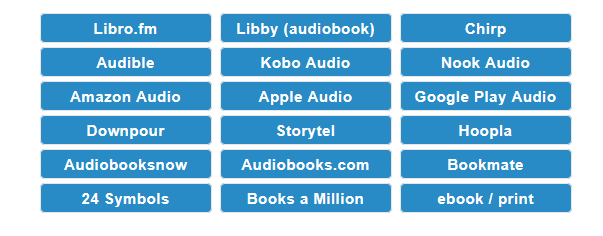
After that, there’s an incredible array of audiobook stores, use whichever ones suit you best. Again: I’m trying to move people away from using Amazon/Audible. I’ve listed Kobo and Nook audio preferentially above just because those support Kobo and Barnes&Noble (which are better than Amazon). Sometimes I hand out audiobook codes through Audiobooks.com (because they’re partnered with my distributor Author’s Republic), but otherwise, I have no real preference beyond the first three above.
Bookshop.org Bookshop is my absolute favorite for paperback books! Again, because a portion of the sales goes to support local bookstores. I’ve bought an embarrassing amount of paperbacks through Bookshop. I usually keep a few in the cart to save on shipping by ordering them together, but it’s a very viable alternative to Amazon. This is my #1 choice for print book buying! (Beyond your local bookstore — which you should also support! Any book on Bookshop should be available for ordering through your local bookstore. But you can save yourself the trip and order through Bookshop and still have the credit go to your local store. That’s the genius of Bookshop’s business model.)
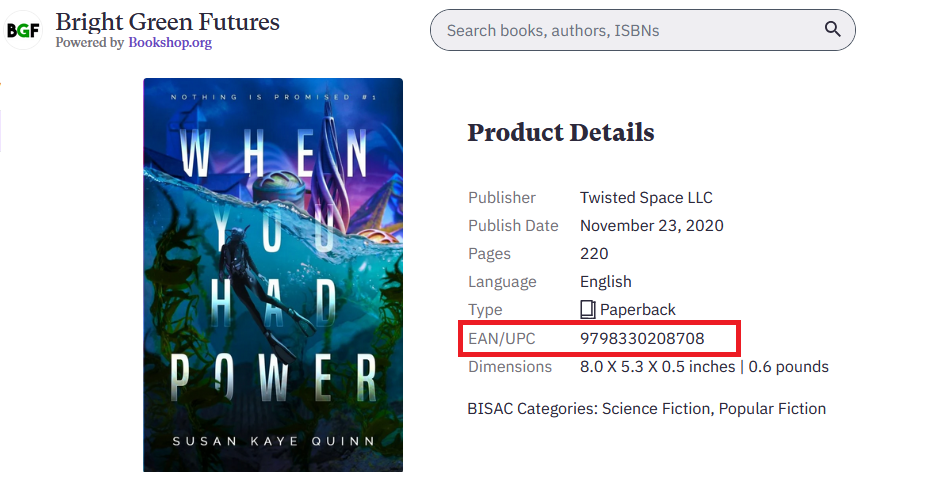
Barnes & Noble (online or in-person stores) Barnes & Noble might be your local bookstore! (Although I suspect you have an indie one as well). They have author events and all kinds of reasons to go into the store itself, but you can also order print books online, to be delivered to your house, just as you do from Bookshop. Or you can order them from inside the store. Most of my books are distributed by Ingram, which means they’re available to order at Barnes & Noble just like any other in-person bookstore. If they have a hard time finding them, give them the ISBN number (also called EAN/UPC) of the book, which you can find on Bookshop.org:
Local Bookstores and Libraries Most of my books should be available to order from your local bookstore or library even outside the US. This is because I distribute with Ingram. So if you can’t order through US-based Bookshop, for whatever reason, check in-person at your local bookstore: they may be able to order the book.
Amazon I do still have print books available for purchase on Amazon. They’re my last choice, but if you’re outside the US, they might be your only way to get them online. Bookshop is currently only available in the US (for self-published authors anyway) and Barnes & Noble is US-based. As noted above, if you’re outside the US, check your local bookshop first to see if they can order it.
A note on used bookstores: while I appreciate the circular economy in all its forms and I love Little Free Libraries, the one downside to these models is that authors don’t get paid. So if you can afford to buy new books, that helps feed the ecosystem. If you can’t, feeding the library ecosystem is a good second choice. But used print books, either buying from used bookstores or sharing with your friends, are absolutely legit parts of the ecosystem as well. And your local library will often run book sales with the proceeds supporting the library! All of the above is better than buying used (or new) print books through Amazon.
My Books Are Still Widely Available
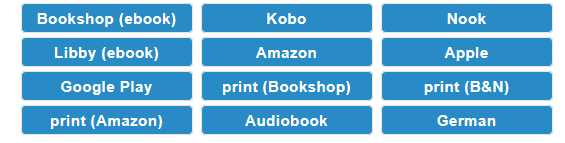
If Amazon is so bad, Sue, why are your books still there? Because we all live under the boot of capitalism and I’m not going to make it difficult for people to find my subversive solarpunk stories that are trying to fix that problem. Plus I’ve got a big catalog and it takes time to get all my books uploaded to better places (like Bookshop). But mostly, I know there are mitigating reasons of all kinds why people stay on Amazon (for now)… what I’m trying to do is give readers an off-ramp and encourage them to move.
Incremental changes count…
Maybe next time your kindle dies, you get a kobo instead.
Maybe you start using the library a lot more.
Maybe you discover a new local indie bookstore and you start ordering all your books through them.
It takes time to change our habits and the world is a crazy place, making everything more difficult. For now, I’ll keep my books available on all the retailers. Despite the evils of Amazon, including shoving an AI chatbot into my ebooks without consent. Despite the fact that pirates are stealing my books as soon as I publish them, uploading them to pirate libraries that the AI corps use to train their AI. Despite all the bad things, the good things are happening alongside them: people are supporting their bookstores and libraries, starting new bookclubs, and generally supporting the literary ecosystem that a functioning civil society needs to have.
And a sustainable and just society as well.
Be well. Read books.
Peace and Love,
Sue
NOTE: Not all my books are on Bookshop yet, and my website is still a mess, but I hope to have the whole catalog shaped up soon.