
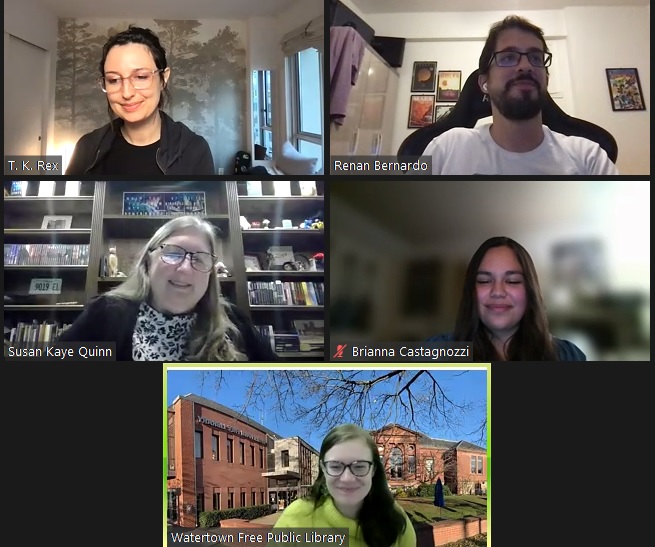
Virtual Author Hopepunk Panel
Watertown Library
Jan 24th 2023 (recorded)
QUOTES FROM THE RECORDED PANEL
“A common theme (in these stories) is instructions for a livable future, especially for solarpunk.” — T.K. Rex
“One of the cores of hopepunk, for me, is resilient communities and protagonists, and that means protagonists that don’t depend on companies, don’t depend on profits.” — Renan Bernardo
“I like dystopian fiction, however, when we seed media with nothing but dystopian fiction, we convince ourselves, us being the general public, that this is the world and how it’s going to end up. And if this is the outcome, why should we spend any energy trying to fight that? That’s why I think putting solarpunk and hopepunk out there is so important.” — Brianna Castagnozzi
PANELISTS AND THEIR WEBSITES/WORKS
Susan Kaye Quinn (website): Sue is an environmental engineer/rocket scientist turned speculative fiction author who now uses her PhD to invent cool stuff in books. She writes hopepunk climate-fiction full-time and believes being cozy/gentle/healing is radical and disruptive. Sue’s hopepunk can be found in DreamForge magazine and Grist’s Imagine 2200 contest.
Check out Sue’s fiction:
- Seven Sisters (short solarpunk, text/audio)
- The Joy Fund (short hopepunk)
- When You Had Power (solarpunk novel, ebook/print/audio)
Sue’s Recommended Read: We Must Believe the Road Ahead is Full of Light (by Lisa Timpf, poem)
T.K. Rex (linktree): T. K. Rex is a science fiction and fantasy author of mostly British and Ashkenazi descent, raised by witches in the western states and currently pretending to be a Silicon Valley tech worker for purely research purposes and not at all because she still owes $40,000 in student loans. You can find her mostly non-cynical, mostly climate-themed stories in Strange Horizons, Asimov’s, Reckoning, and elsewhere.
Check out T.K.’s fiction:
- A Holdout in the Northern California Designated Wildcraft Zone (short solarpunk, text/audio)
- My Favorite Shape of All (novelette, Queer Blades anthology)
T.K.’s Recommended Read:The Dispossessed by Ursula LeGuin
Renan Bernardo (website): Renan Bernardo is a sci-fi and fantasy writer from Rio de Janeiro, Brazil. He has stories published in multiple languages and magazines, including Apex Magazine, Solarpunk Magazine, Podcastle, and Daily Science Fiction.
Check out Renan’s fiction:
- A Shoreline of Oil and Infinity (short solarpunk, text/audio/podcast)
Renan’s Recommended Read: The Spider and the Stars by D. K. Mok (short solarpunk)
Brianna Castagnozzi (Twitter & Tumbler): Bri Castagnozzi is the co-editor-in-chief of Solarpunk Magazine. Her work has been published in Stonesthrow Review, Shawangunk Review, Entropy, and Clarkesworld.
Check out Bri’s fiction:
- Keiki’s Pitcher Plant (short solarpunk, OwnVoices)
Bri’s Recommended Read: Sweet Water From Salt by Jeremy Pak Nelson, in Solarpunk Magazine’s first all-BIPOC-authored issue, Colorful Roots (July 2022)
AUDIENCE QUESTIONS AND PANELIST ANSWERS
- Q: Curious how TK, Renan, and Brianna react to the word you used about hopepunk, Susan: gentle. The vibe to me is about collaboration and interconnection, but I’ve not yet heard gentle as an overarching characteristic. (Though I’m more familiar with solarpunk than hopepunk–if they are indeed separate)
RENAN: Gentle is an interesting word, indeed. It evokes a bit of the empathy I mentioned in the talk, but it also conveys a sense of community, of being gentle with each other, with the planet, with your community, and even with the inevitable things you don’t like. At the same time, other words that Solarpunk/Hopepunk evoke are not so gentle. Defiance, for example, is another good word, which I think comes from the punk roots in its name. It means to be bold, defiant, and “not-so-gentle” against the status quo, against fossil fuels, exploitation, supremacist thoughts, and so on. So I think hopepunk and solarpunk work well with this duality: they’re gentle, but they’re also obstinate.
T.K.: I don’t know if it’s a requirement and I don’t really think it should be, but it is pretty common and it seems like a lot of people kind of need gentleness right now. I would say that in my own fiction, the stories where I go too gentle, no one wants to publish, and honestly it can be a lot of fun to push a narrative into surprising escalations, but they certainly don’t have to be violent. Emotional stakes can be just as gripping as life-threatening or world-threatening stakes. It can be tempting to write a gentle solarpunk story that’s just literary fiction set in a pleasant future but it runs the risk of being boring. I like my fiction weird. If you’re going to go gentle, go weird.
Sue: Gentle has a lot of different connotations, just like hope. Words are slippery that way. Many hopepunk stories choose gentleness as an aesthetic, almost a cozy feel to the story as well as the world (Becky Chambers’ Monk & Robot series is a great example of this; Studio Ghibli has gentle down to an art form). To me, gentle stories are a rebuke to the brutality of the world (both the gentleness and the brutality can exist in the same story). Even deeper, it’s an elevation of care work, healing, and restoration as important values, which I think is very disruptive to story worlds (and real ones) where violence is assumed to be a superior way to resolve conflicts. It underwrites compassionate solutions. (Which I think are very punk!) In hopepunk/solarpunk stories, there’s a wide spectrum between stories with a fully-cozy/gentle aesthetic and those with a single character who chooses gentleness as their philosophy of living. But most have some taste of gentleness somewhere.
- Q: I’d love to hear from the panelists how online culture and the internet has influenced and helped build the hopepunk movement. I know for myself that I find my most influential and interesting pieces online, but I don’t know how much I see this genre/aesthetic in “real life.”
RENAN: I’m not sure if I understood this one correctly. I’ll leave it to the others, then I might add something later.
T.K.: I was raised by hippies and lived on a commune for a few years growing up, and that “real life” experience has consistently been a much bigger influence on my worldbuilding than anything I’ve found online. Solarpunk is absolutely an emerging lifestyle in addition to a genre and artistic aesthetic, and it builds on many real-life efforts to decolonize and live more sustainably in stronger local communities — a struggle that goes back to the beginning of colonialism even in Europe (which colonized itself first). Permaculture, environmentalism, systems thinking, holistic approaches to everything, radical inclusion, prioritizing community and taking mental health and disability seriously – this is how I was raised. It was always going to be part of my fiction. It’s great that it’s increasingly discussed online.
SKQ: Whereas solarpunk has an identifiable IRL “movement”— folks who try to live an environmentally sustainable lifestyle in real life— hopepunk is more of a broad-based impulse that I see as a reaction to “living in dystopian times.” It hasn’t coalesced into a distinct real-life “lifestyle” so much as crept into storytelling across a wide range of mediums. I’ve seen it called lots of different things, as people nibble at the edges of the idea they don’t want to doomscroll their way through life— they want stories where characters are compassionate and work cooperatively. Often those stories center around the climate, but not always: a lot of Sweet Weird is hopepunk applied to absurdist stories (often comics or animation) as people are searching for compassion stories about friends helping each other… very hopepunkish themes. I often think it’s a zeitgeist as much as anything else, but I’m a storyteller, so I’m focused on figuring out how to tell those stories in an intentional way… and how to get more of them out into the world. (Btw for both hopepunk and solarpunk, there’s a much more vibrant ecosystem of short fiction, whereas the novels/movies are just starting to be published/released–short fiction often is a laboratory for longer works, so I think this movement is still young.)
- Q: Can hopepunk and solarpunk be written in a present setting? (Solarpunk is often seen as a form of scifi and so people often worry that its downside is that it might put solutions far in the future rather than see what can be done with the tools we have today)
RENAN: Yes! I think they can be written in a present setting. Some of my stories are actually set in a very near future. But speaking of the present, we have lots of things going on right now that require a Solarpunk “answer”. Sometimes what we think of as “future” is just something that isn’t happening right now, but that could happen. It doesn’t only apply to solarpunk/hopepunk, but to other kinds of SF as well, including dystopian fiction. If my story is about a protagonist who decides to illegally (and boldly) install solar panels in a lot of buildings and wire them to the power grid, then it’s about something that isn’t happening (as far as I know), but something that could well happen and is totally solarpunk.
T.K.: I’ve written it in a present setting, but no one’s wanted to publish it so maybe we’re not really there yet or maybe I just don’t know how to do it very well. It’s probably harder to find a market for because it’s not really the kind of sci fi that people expect in sci fi markets but it’s not exactly literary either (I guess? I don’t know what literary is). Magical realism / urban fantasy is kind of a sweet spot where I think this has been living so far.
SKQ: Hopepunk/solarpunk can definitely be written near-future or present time. My series is near-future. Kim Stanley Robinson’s Ministry for the Future is very near-future. I’ve heard it said that soon all fiction will be climate-fiction simply because the climate can no longer be ignored. To your point of having solutions-based stories that show what can be done with the tools we have today, especially with regards to the climate–this is a huge topic in climate circles, this call for near-future solutions-based stories that can inspire people to change. Just today I shared a call for present-time stories focused explicitly on impacts people can make today (Climate Story Fund). Whether we have editors of magazines or publishers that are ready to publish those things is a separate issue–but people are writing it, and I’m passionate about seeing all kinds of hopepunk/solarpunk stories out where readers can find them and be inspired.
- Q: TK mentioned how Hope/Solar punk can cross genre; can alt history encompass hope punk? — showing how small changes in society/attitudes/technology in the past could have changed our present?
RENAN: Yes, totally! There were scientists talking about climate change and foreseeing a crisis far back into the XIX century. There could be an alt-history story about someone moving to shift the industrial revolution into another direction. In my opinion, that would be a Solarpunk story set in the XIX/early XX century (And I’d totally read it!)
T.K.: I think so, yeah. I can’t think of any examples in print but I’m not the most well-read by any stretch of the imagination. The closest thing I can think of is the TV drama For All Mankind. The opening scene of the series is the moon landing – but it’s not Neil Armstrong, it’s the Soviets. And then history changes from there. No spoilers hopefully but the alternate timeline that results is both relentlessly optimistic and insanely high-stakes, and I love that show for how it always brings things back to that through line of optimism for the world no matter how hard it makes things for its characters. Also: The only difference between alt history and science fiction is where you are on the timeline when you read it.
Sue: Absolutely would love to see more alt-history hopepunk/solarpunk! What a great way to interrogate how we got here and how we shouldn’t assume the world is unchangeable— we’re changing it every day. That’s why I’m so passionate about the genre and getting more of these stories out there: let’s collectively dream up a better world and then make it happen!
FURTHER HOPEPUNK READING
Short Fiction
- Grist’s Imagine 2200 solarpunk anthology (2021, 2022)
- The Last of the Mbahuku Tribe by Oyedotun Damilola
- Cable Town Delivery by M. Lopes da Silva
- El, the Plastotrophs, and Me by Tehnuka Ilanko
- O cio da terra (The Earth in Heat) by Raquel Setz
- Look to the Sky, My Love by Renan Bernardo (Solarpunk Magazine, Issue #1)
- The Hilarious Inside Joke of Our Overwhelming Melancholic Nostalgia by Francis Bass
Novelette
- Roots in the Box and Roots in the Bones by T.K. Rex (in Asimov’s Jan/Feb 2023)
Novels
- Psalm for the Wild Built (Becky Chambers)
- Ministry for the Future (Kim Stanley Robinson)
- Blackfish City by Sam J. Miller
- All the Birds in the Sky by Charlie Jane Anders
- The Last Unicorn by Peter S. Beagle
- Foxhunt by Rem Wigmore
- Arboreality by Rebecca Campbell (finalist for Philip K Dick award, 2023)
Graphic novel
- Shifting Earth by Cecil Castellucci, Flavia Biondi, Fabiana Mascolo
Film & TV
- Kipo and the Age of Wonderbeasts (2022)
- Nausicaa of the Valley of the Wind
- Princess Mononoke
- Star Trek (especially Strange New Worlds and Discovery)
- Free Guy (2021)— hopepunk
- Strange World (2022)
Collections (Nonfiction, Fiction, Poetry)
- All We Can Save (ed. Ayana Elizabeth Johnson, Katharine K. Wilkinson)
HOW TO HELP FIGHT THE CLIMATE CRISIS:
- Get a home energy audit to see how you can conserve energy (check your local utility— they may offer free audits!)
- Check out this easy guide to the new federal tax rebates for EVs, solar panels, heatpumps, energy efficiency/insulation & more — tell your friends!
- Advocate locally for your town council & schools to get energy efficient
- Join an organization like Solar United Neighbors or Third Act to learn how to advocate for change
- Form local mutual-aid networks by simply checking in on your neighbors and friends
- Sign up for Grist’s solutions-oriented environmental reporting newsletter and share hopeful actions taking place right now—people become energized to act when they see others taking action.
- Support local efforts to build urban community gardens like Grow Boston
- Join a CSA (Community Supported Agriculture) farm share to get farm-fresh food (eating locally is less carbon intensive)
- Try Meatless Monday (reducing meat consumption reduces carbon emissions)
- Look for local organizations already doing the work to improve your local environment (like Watertown Citizens) and donate/volunteer
- Most Important: VOTE to support public officials who understand the climate crisis