I started my week of celebrating middle grade science fiction with a guest post from Greg R. Fishbone (author of GALAXY GAMES)
about the hole on the bookshelf where MG SF should be. In some ways, this is a
longing from my childhood. I read so many great SF books, from luminaries like
Frederik Pohl, that I want to recreate that experience for my own kids. I want
to point them toward books that will broaden their horizons and make them think
in ways they never have before. Something Frederik Pohl said has stuck with me: that when he started out (with writers like Arthur C.
Clarke), they didn’t plan to invent a genre. They just messed around with
stories they loved.
I think it will come the same way – from people messing around with stories
they love. And because of the biases that Greg talked about in the industry
with regards to MG SF, I suspect that some of the ground-breaking
messing-around will come from people who self-publish stories that they love.
author of Shelby and Shauna Kitt and the Dimensional Holes, who is
breaking ground by both self-publishing and bravely going forth in a genre that
isn’t “popular” in e-books … yet. Here’s the blurb:
Shelby Kitt never gets lost. Shauna, his sister, never gets sick. As far as most people are concerned, the inseparable Kitt twins are odd 13-year-olds. No one, however – not even Shelby and Shauna – can guess how extraordinary they are until they are chosen for a dangerous mission. From that moment on, Shelby and Shauna Kitt discover that the universe is full of klodians, cities in jungles, giant bats, and tea with mushrooms. Most of all, they discover that it takes more than special powers to face – and survive – the evil that threatens the galaxy.

Me: Patricia, what
motivated you to write Shelby and Shauna? Did you have a particular
purpose in mind, or were you just messing around with a story you loved?
a particular purpose – the story just developed in my head, and then pretty
much took over, so that I was always thinking about it (even before I started
writing). I knew what would happen at several key points once I began writing,
and I knew most of the ending long before I knew bits and pieces in the middle.
The story went through several drafts, so that I could eliminate
inconsistencies, polish the characters, and even change my mind about certain
things. I suppose I could also say that I’ve been coming up with the plot for
years, dreaming about different worlds, exciting adventures, and so on – and
I’ve known for a long time that I wanted a boy and a girl to be the heroes of
the book. I wanted to write a novel where both were equally important and
interesting, and where both had to work together to do something great.
English (yay for Ph.D. types!) and teach literature. I know how academia
can be, and it’s not always the hotbed of innovation you might think. What
inspired you to self-publish Shelby and Shauna, and did you think
you would go down that path?
I should say that literature taught me pretty much all I know about writing and
story-telling (back in the day, I attended a British school, where the reading
curriculum consisted almost entirely of “classics”). Having a full-time
academic job, I didn’t think I’d have the time necessary to query agents
and publishing houses (and I was right). So I put all my efforts into writing,
editing, polishing, and finally publishing. In addition, I was excited to be
part of a growing number of independent writers. It is exciting to see that
more and more people are reading independent novels and seeing the talent
that’s out there.
living, what kind of responsibility do you think middle grade and young adult
authors have to their young readers, in terms of moral messages and story
messages?
responsibility to create stories that inspire readers. In Shelby and Shauna,
I wanted to show that heroism can mean many different things. I also wanted to
highlight the value of friendship, teamwork, creativity, courage, and
compassion, which I think are essential qualities to foster for the 21st
century.
to Neal Stephenson’s article, which posited that SF writers have an obligation to inspire future scientists –
to create in fiction the inventions of tomorrow, so that scientists will do it
for real. He held up the model of classic SF authors (like Frederik Pohl) who
literally invented the future in their fiction. As a scientist and SF lover, I
strongly disagree with this view, taking the position that writers reflect the
world they live in—the collective aspirations and hopes of the people of their
time. While authors can inspire (and should strive to inspire), their prime
obligation is to tell the truth by telling great stories. I believe this is
particularly true for children’s novels. As an SF writer (for kids) what are
your thoughts on this?
on this one. It’s creativity that creates the inventions of tomorrow, not
specific books or authors. It’s the job of the writer, perhaps, to stimulate
creativity, not take it away by showing exactly what should be created.
Stories, ultimately, are only compelling if we can resonate with them, if we
can on some level understand what it means to be human as we read. Sci-fi
novels may present us with other worlds and technologies, but it does so in
order to showcase human struggles and emotions, as well as human character development.
There is also a highly personal element to the “truth” authors tell.
For example, as a young teen I moved from Rio de Janeiro, Brazil, to
Vienna, Austria. I later incorporated my own childhood experiences and
international travels in the sci-fi world I created in Shelby and Shauna. Valmorax,
the capital city of planet Miriax, is a place that reflects a mixture of
Brazilian and European influences. The novel also reflects, through the
adventures of Shelby and Shauna in a parallel dimension, the sense of
excitement I felt when I thought about travelling to an unknown place with a
different culture, language, and climate.
what you’re working on now, and when we can expect a new release from you?
Shauna, and I’m having a great deal of fun accompanying the Kitt twins
on their new adventures. I plan to release book 2 of Shelby and Shauna
Kitt in the summer of 2012.
to talk about my work!
Buy Shelby and Shauna Kitt and the Dimensional Holes
E-book
$2.99 on Amazon
$2.99 on Barnes and Noble
$1.99 on Smashwords
Print
$14.99 on Createspace
Signed copy
There seems to be a small surge in MG SF, in both self-pub and trad-pub. I can only hope that this takes hold and starts to fill the bookshelves. I would love to see a middle grade science fiction story that breaks out, doing for SF what Harry Potter did for Fantasy – show that serious science fiction isn’t just for adults. Books like Hunger Games are starting to do that in YA, allowing a constellation of books in the genre to follow. Maybe, if we sprinkle some rocket-powered moon-dust on the bookshelves, someday …
More NEW SF books for kids! Add your own recs in the comments!

Jacob Wonderbar and the Cosmic Space Kapow by Nathan Bransford
Jacob Wonderbar is used to detentions, but when a spaceship crashes near his house, he finds himself in a whole new level of trouble. After swapping a corn dog for the ship, he and his two best friends, Sarah Daisy and Dexter, take off on a madcap adventure. They accidentally cause an epic explosion, get kidnapped by a space pirate, and are marooned on planets like Numonia and Paisley, where the air smells like burp breath and revenge-hungry substitute teachers rule. And that’s onlythe beginning . . . It turns out that there’s an entire colony of space humans, and Jacob’s long-lost father just might be one of them.
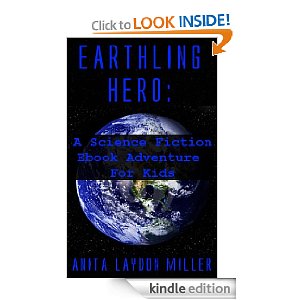
Earthling Hero by Anita Laydon Miller
11-year-old Mikey Murphy wakes to find a stranger in his room—a kid who looks exactly like him. Meeting his alien clone and his clone’s sister is just the start of Mikey’s adventures. Can he befriend the siblings, bust into a military installation, fight expert assassins, discover an evil alien’s lair and save the world?
Another fabulous post, full of good questions and insights. Thanks again for this series. I've downloaded all the e-books you mention.
The indie revolution is a great things on many levels. Diversifying what's available is a big one.
Great post, ladies – thank you! 🙂
*snicker* I'm going to tell DH the Permanent head damage line. He he he. Great interview. Yeah for sci-fi and yeah for MG!
Great interview! I've heard of Ph.D. meaning "Piled Higher and Deeper" but I prefer the "Permanent Head Damage" acronym. Writing a journal article is WAY different from writing fiction, though I believe training in research can help writing for all formats. Good luck with your indie releases!
Glad to see that I'm not the only one that's noticed the lack of good SF nowadays for the young people! I may have to take a look at Shelby & Shauna.
Good interview, good blog,
Thanks so much for mentioning EARTHLING HERO! Indie epubbing it and A SCARY GOOD BOOK is a fun experience. I think the Christmas season will be very telling…I think it will show whether indie epubbers have a shot at "making it" in publishing. Exciting times!
@DT Yes indeed! I'm hoping that will change in the near future! Thanks for stopping by. 🙂
This post could not have come at a better time! I'm in the midst of a MG Sci-Fi, so thank you for posting this information. Advice applied!
I've launched a giveaway today! 🙂
@David Yay for MG SF writers! That's the first step… 🙂
Timely topic. I'm not a writer of that age category/genre, but if you want some editor perspective on just where MG sci-fi is going, check out today's Appendix podcast.
*Note, I'm in no way associated with this podcast. I just got to listen in when it was being recorded and it went up today.
@Stephanie Thanks for the tip about the Appendix podcast.
I don't think SF authors should feel compelled, as part of the job description, to invent the future science of the world – but if they do put their creativity to use in such a way, all the better. I mean, I think of Jules Verne writing about travelling to the moon and under the sea before such technology was even remotely possible. I mean, he was positing rocket technology to reach the moon in a novel in 1865, almost half a century before we'd even figured out how to fly a plane.
So, writerly invention is good! But it's silly to say this is what writers have to do. There are a million different types of writers, with a million different goals for their writing.
But another Jules Verne would be kind of cool.
I have a MG SF rec for you. October 12 post on your blog 😉
https://susankayequinn.com/2011/10/meet-simon-haynes-author-of-hal-junior.html