2017: A term is coined

WHAT IT’S NOT
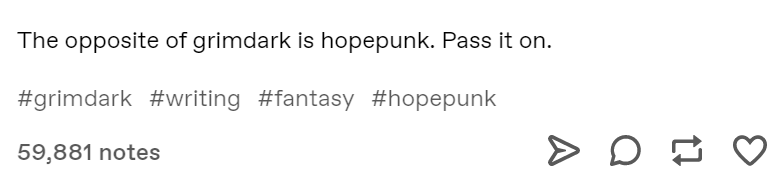
Naive. “Nice.” Sunshine and rainbows and utopia (at least not the kind you’re thinking). Hopepunk may be the opposite of grimdark, but that doesn’t mean it’s not grimy.
WHAT IT IS
Weaponized optimism.
An understanding that the fight never ends.
Radical compassion, cooperation (as opposed to violence) as an organizing principle, and a conscious choice to believe in kindness.

A REFLECTION OF REALITY
All art reflects the time in which it is born. Hopepunk is a label for a genre of writing, but the world in 2017 was birthing a whole collection of movements and aesthetics that were consciously, intentionally, stubbornly and willfully choosing things like gentleness, goodness, and optimism. It was a direct rebuttal to a world filling up with hate and violence. It was hygge and wholesome memes and kawaii.
And while it may choose kindness in a defiant way, hopepunk is not here to play. It is not “nice.” It’s a radical way to be in a world that’s bent on darkness.
SOMETIMES YOU DON’T KNOW YOU’RE SEARCHING
I can look back on my work and see the early traces of me striving to write something that stepped out of the Hero’s Journey and spoke to something more. Different. I saw it in 2015, in the first book of my Singularity series, in Delphina’s performance in the Creative Olympics:
| “I am a work of art. I am not the leftovers of humanity. I am not a vestigial organ floating inside the belly of Orion. I am meat and blood and electricity, but we… we, the collective breath of the human race, are more than all of that combined. We speak the language of the soul because encoded deep in that spark, we know: we are created. And someday the Creator will come back and say, My children, what have you done? And I will say, I am still here, flesh and bone and aching heart. Still sweating and fighting and making sweet love. And in that transcendent act, I have become the creator, making again in the Creator’s image, reaching for a kind of perfection not free of mistakes but forged into realness through them.” The Legacy Human, Singularity #1, 2015 |
I found it in a more conscious way in 2017, in the second of my Mindjack trilogies. Hopepunk is Zeph, the cynic, deciding to care…
| The way she looks at me sometimes, even now, when she’s hurting and angry, and I’m sure she’s railing at the world inside her head, but she still has that bright expectation that the world is a good place. A decent place. Or that if it’s not, it should be. That’s something worth fighting for. Locked Tight, Mindjack #4, 2017 |
AND SOMETIMES YOU DO KNOW
By 2019, I was fully aware I was searching for a new kind of story to write. A new way of writing. A New Mythos, as described by my friend PJ Manney: “…stories about truth and what that entails, community, cooperation, competence/expertise… and working together to create the greater whole.”
But what on earth did that mean?
In 2019, I wrote my first explicitly hopepunk novel, the last of my Singularity series, long delayed because I didn’t have the right framework for it when I started. Now I did, or at least, I’d found the edge of the wildlands and was ready to try my luck.
| Because he killed her. Not directly—I don’t much like Marcus, but he’s not that kind of monster. His ambition blinded him. The sin of ambition is still among us. In Marcus’s hubris, he ignored the warning signs. He was convinced the pill he gave his mother would ascend her just as it had for him. He talked her into it. And then the procedure killed her… as it did for so many in the first Singularity. Those deaths marked humanity’s true original sin. The conscious one that Marcus—and all ascenders—needs to atone for. Not as punishment, but as confession. A reconciliation with what they lost. What they failed to understand. That’s why I’m here, as I see in a flash of clarity that makes this artificial world around me seem to pulse and expand, just a little. Marcus sees it, and fear grips his face. He casts around for the source. It’s not just me making his world move—it’s him. We are, after all, connected. There must be no purging of the past, no erasure of what we were before. We have to embrace all of it, and leave no one behind. This much I know. But Marcus won’t get there by staying in this hologram of his own guilt. The Last Mystic, Singularity #4, 2019 |
AND THEN ALL HELL BROKE LOOSE
Pandemic. Political strife. Insurrection. I’m writing/revising this in April 2022, and we all know what the last few years have been. In making sense of that insanity, literally in the midst of it in Summer 2020, I forged deeper into the wildlands in a serious way, determined to flesh out what writing hopepunk meant to me. Because I was a writer, and the world needed stories that pointed the way.
My hopepunk climate fiction series, Nothing is Promised, was birthed out of that need, and I blogged my way through the experience of getting that on the page.
From August 31, 2020:
| Life in 2020 is… fraught. That’s a word that keeps banging around in my head, and it seems to fit every day. I don’t need to explain it—worldwide pandemic, political and racial unrest, a tremendously uncertain future. We’re all living it. Which is why I’m writing a new hopepunk series, urgently, right now. I’m not inventing calculus during the plague, but on top of keeping my family safe and navigating all the sudden obstacles thrown in our way to simply cast a ballot, I’m diving deep into this new genre, in both form and content. In 2018, I joined a writer’s group called The New Mythos, dedicated to exploring the idea that the SF world needed a new way of telling stories. Of course, we were all actively engaged in that before the group formed, but our collection of futurists and authors have been bouncing ideas around, sharing and poking at the concept. It’s not limited to hopepunk, but that genre sits comfortably in this domain. The concept is not easy to quantify, much less put on the page. But it’s exciting as all heck, and exactly what I feel driven to write right now. And driven is the right word. For a while, I wasn’t sure I could actually write this during the pandemic. Whether I had the energy and emotional bandwidth to rise to the challenge of this work. And the virus may yet scuttle my plans—it’s already stricken friends and family. Planning anything in 2020 feels audacious. But it feels urgent to write this right now, in the middle of all of this. Creating hopepunk at a time when things are hard, when everything is terrifying, and the world is fraught… that’s what this genre was born from. That’s the scream of the birthing, the cry of the newborn, the promise of new life. It’s all there. Right now. So I’m taking the leap to tell you I’m working on this even though it’s not done. Daring to invite you on the journey with me, even though I’m not at all sure we’ll make it through. I am halfway through the first of four books, so that’s something. Nothing is Promised. It’s the truth… and also the title of the series. |
If you made it this far, good job! Have a cookie.
What follows is an ongoing series about crafting stories in this new genre, hopepunk, which over the past two years, I’ve only seen gain momentum. Slowly. As we’re all feeling our way through the wildlands and finding each other… which is exactly how it always works.
Welcome friends! Stick close. We need to stay together to make it through.
NEXT: On Writing Hopepunk
You reminded me that I wanted to write about hopepunk! Thank you! https://meta-narrator.com/2022/04/29/real-life-hopepunk/
Thank you for that lovely shout-out and post! The real-life aspect of this–I’m so glad you spoke about the Ukrainians–is a huge part of what’s compelling to me to write in this genre. We *need* stories like these–a lot them. I hope that Becky Chambers is paving the way for a whole lot more to follow in her wake.
I hope so too! Thanks for doing this important work!