It all comes down to the purpose of violence.
There are so many aspects to our world that we simply take for granted, until the world is turned upside down and nothing makes sense anymore. A worldwide pandemic sweeps through, halting everything for a few breathless moments, and suddenly people rethink their lives and decide to go back to school, start that business, move back home… write that novel.
In 2019, I took a retreat and dove into the history of science fiction, searching for my place as a writer in the pantheon of speculative fiction writers (famous and less so) before me. I came away with an amorphous determination to write something very different, with a vague manifesto that included this:
I am determined to write feminist, hopepunk, New Mythos, transgressive SF, exploding all our problems about collectively living in this world and creating one that’s not a dumpster fire. I want to write the fresh untold stories, the feminine as the universal, the people of various colors and sexualities that weave the rich tapestry of humanity. I want to embrace the full freedom of indie publishing to write literally anything you want. I don’t have to do these all in every book—I will write lots of books—but I want to create a body of work that encompasses all these things.
I didn’t know we would soon have our world turned upside down by the pandemic. I had no idea I would, a year later, be hacking my way through writing hopepunk climate fiction. But I was already laying the foundation for the determination to write something different.
But having the amorphous desire and creating that work on the page are two widely separated things.
The pandemic swept away everything else—it fanned the flames of this burning need—but I still had a lot of work to do to take hopepunk apart, examine what it was made of, then put it back together so I could use it as a tool to create what I wanted.
From September 14, 2020:
Dystopia and Hopepunk
I stumbled across a post (Love, Hope, and the Dystopian Darkness) by accomplished author David Corbett, which I found delightfully vulnerable and perceptive. He’s writing a dystopia and waking from 3am nightmares about the real world (me too, David) and wondering if anyone will want to read that kind of work right now.
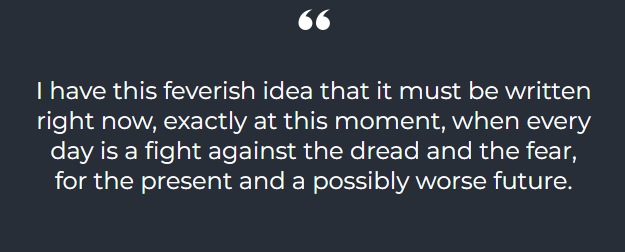
Drawn in by that vulnerability and his conclusion that a thread of hope through his work would make it meaningful to today’s readers, I left a lengthy comment. The gist was explaining hopepunk and how I’m driven to write it, right now:
Later, this showed up on my twitter mentions:
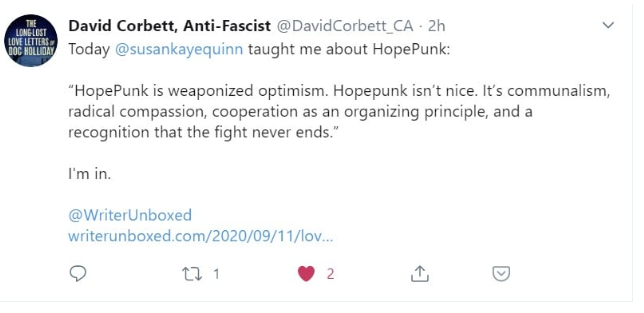
| I love planting the idea of hopepunk and watching it blossom in another writer. This is the way. Sharing our difficulties with full vulnerability, right here in the middle of it? That’s hopepunk as hell. I always enjoy connecting with other authors, especially geeking out about craft and storytelling, but this exchange with David had a deeper level to it—we were storytellers, grappling with how to tell stories in a time of turmoil. Not just what readers expect or respond to, but what we’re compelled to write. He was coming from the darker side, wondering how to reframe his story to bring hope to his readers. I’d already tossed aside the idea of writing dark (sorry, Debt Collector), focusing instead on reframing the question: how do you write the future you want to see while staying real about the persistent challenges to getting there? David’s response (“I’m in”) is exactly what I hope readers will say. It was a meta-moment. Most stories have a thread of hope through them. Story structure is almost defined by the triumph of characters over some form of darkness. So, what makes a dystopia different from hopepunk? Many things (and I’m not a genre purist by any means), but the key, I think, is the purpose of violence in the story. Dystopias are set in a cautionary-tale world gone terribly wrong. Characters are making the best of terrible circumstances, often having to make morally-compromised choices and dealing with the emotional fall-out from that. It’s compelling storytelling. It’s also, often, predicated on a world where some kind of violence is the organizing principle. It’s a given that tributes will be selected for the Hunger Games. Katniss kills because she has to, although at a certain point (spoilers), she refuses to play the game. Violence, even in rebelling against it, is still the fundamental principle by which the world is organized. It is normalized, even if individual characters chose to fight that system. Some would say that’s just “the real world”—as if the “natural” state of humanity is violence. And while it’s obviously true that violence exists, I submit it’s equally obvious that violence is the aberration. The “natural” state is love, families caring for each other, friends watching out for one another, communities cooperating to build roads and schools, states working to protect common lands and care for the displaced, and finally nations working toward a common purpose, a national pride rooted in common culture and history. Violence is an aberration that has to be dealt with, but if it were the norm, humanity could not have possibly cured polio much less gone to the Moon. Hell, we couldn’t even cross the street without vast amounts of cooperation built into every step. Violence as an organizational principal is a skew on the real world. Of course, all kinds of violence exist in the world, perpetually. Sexual abuse, domestic abuse, racial terror—all of these are real and ongoing. Violence can also be institutional and well-organized. This is still an aberration, rather than fundamental. The darker side of humanity undoubtedly exists and in some places, times, and ways, flourishes. Hopepunk says OH HELL NO to that, chooses radical compassion as the answer, and understands that the battle against that darker side never ends. But it does not accept violence as the inevitable, natural order. Does that mean that hopepunk is utopian (the apparent “opposite” of dystopian)? No. The battle is ongoing and often very grim. But… Hopepunk emphatically states that cooperation is the “natural” state of the social animal that is humanity. And further, that we can choose radical compassion as a solution in the fight against our darker angels. Hopepunk questions the premise. It reframes the question. The hopepunk story I’m writing (When You Had Power, Nothing is Promised 1) is set in 2050, in a world beset with wave after wave of plagues rising out of the melted permafrost and the mingling of animal and human climate refugees. Not exactly sunshine and rainbows. My main character is a power engineer trying to find a family but discovering a mystery instead. There’s gaslighting and green tech and a whole lot of AI, but it’s mostly about persistence and kindness—how we choose the world we want to live in. It’s infused with all the things I’m feeling right now, living in this moment, which is why I feel the compulsion to write it even if that’s a struggle. In fact, precisely because it’s a struggle. Writing hopepunk in the world right now is hopepunk as hell. Peace and Love and Nightmare-Free Nights, Sue |