Hopepunk: collectivism in storytelling
We live in a hyper-individualist world, especially in America. This extreme focus on individualism has many costs—an epidemic of loneliness, the fracturing of the social fabric, the breakdown of communities—and yet we’re still convinced that “rugged individualism” is the pinnacle of American virtue (rather than, say, working together, organizing for a larger cause, compassion for the less fortunate). That’s the narrative, the cultural story we tell ourselves, even as we actually spend time working collectively on all kinds of projects, every day. It’s a strange dissonance that’s reinforced through the Hero’s Journey (more on that later), all our mythology emphasizing that you’re really supposed to do all this alone. Especially women. Double-especially for moms. The things we expect of moms would break most people—and that’s exactly what happens to a lot of mothers. (And, not coincidentally, is one reason why so many are opting out of that altogether.) We expect people at all levels, young and old, all genders, to go it alone, fighting through the hard stuff and the everyday stuff and the grind that eventually will wear you down to a nub… even though we never have, historically, been so very alone in that journey, and we demonstrably can’t make it alone, especially now in the 21st Century.
I’d been questioning the utility (and morality) of the Hero’s Journey for a while, but my explorations of hopepunk just brought that solidly home with a thud. And a bit of discomfort. Because aren’t we supposed to worship heroes? Look up to them? What happens when “hero” is a model that doesn’t work anymore?
From September 21, 2020:
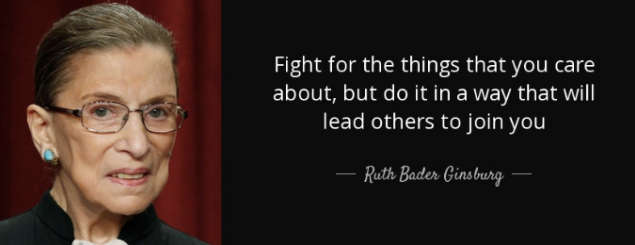
I’m mourning the loss of Ruth Bader Ginsburg, Supreme Court Justice. If there were anyone you could say was a hero, it would be this incredibly brilliant woman who used her towering intellect to fight for (and win!) equal rights for women—and that was before she ever reached the Court. She lived her life in the pursuit of justice, undaunted, undeterred, with nearly superhuman feats of persistence and grit.
Heroes like RBG inspire us.
Heroic fiction tries to capture some of that magic for the rest of us. It allows us to feel like the “chosen one” who will heroically save the world, restoring goodness and justice through superhuman feats.
Reality is much different.
Hopepunk has many facets. There’s the weaponized compassion, cooperation as an organizational principle, the idea that the fight never ends… but these could all be incorporated into a heroic narrative structure pretty easily.
It’s the idea of communalism, the notion that there’s no “chosen one” and that we all have a part to play in bringing justice and compassion to the world—that’s the PUNK part coming out to play. Raw, joy-filled, anti-corporate, rejecting the consumerist rat race and calling out society on its bullshit.
Punkhope isn’t here for your heroes. It knows we’re all messy and complicated and flawed… and that every single one of us has to put in the work to have any hope at all.
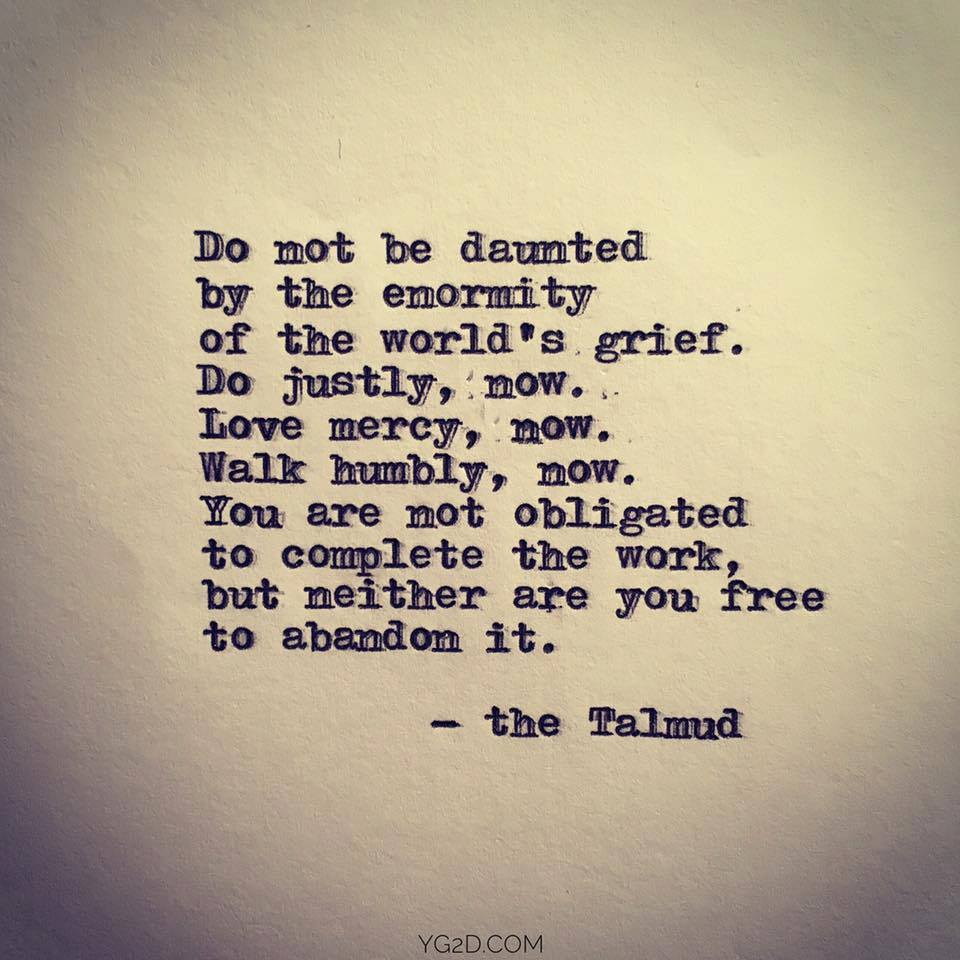
The irony is that heroes like RBG lived by the ethos embodied in that quote from the Talmud—she knew she couldn’t complete the work, but neither was she free to abandon it. So she buckled down and did what she could—which is exactly how anything at all gets accomplished.
People do abandon the work, all the time—they avoid it, look away, fall in line, don’t speak up, do what’s expected. They uphold “the way it is” even when they know that way is wrong. Sometimes, it’s damn heroic just to say I dissent! loudly, and without apology.
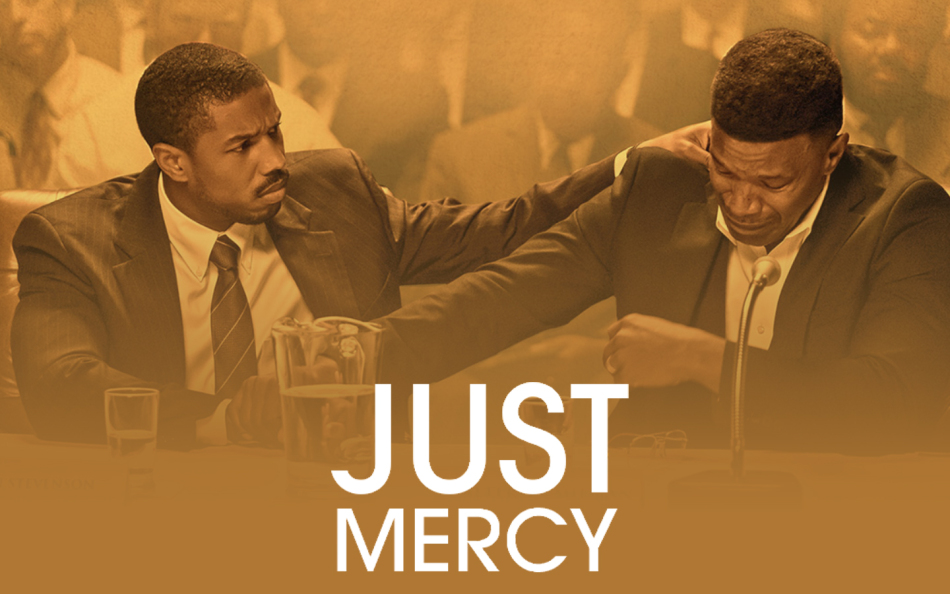
A few months ago, I watched Just Mercy, the story of an unjustly convicted man on death row and the damn heroic efforts to get him free. It’s a spectacular movie. In watching it, two things struck me, hard:
- how the convicted man’s community rallied around him, never giving up, pitching in, taking the hits, each heroic in turn trying to get him free
- how the bad guys in the movie simply refused to be decent. They had the chance. They could have done the right thing any of a dozen times. But they just… didn’t. It wasn’t a grand conspiracy. They didn’t even have to work that hard at it.
They simply didn’t do the right thing when it was asked of them. That’s all it takes. Chilling and brutal and aggravating as hell. But the converse is also true—heroism can be as simple as doing the right thing when it’s asked of you.
So much of storytelling structure rotates around the Hero’s Journey (who’s taking care of the kids during all this journeying? Oh, you mean it’s really a Male Hero’s Journey? You don’t say…), that taking the “chosen one” out of the story could easily feel like there’s no story left at all. This is not true, of course, and this narrow view of “how stories are told” highlights the desperate need for more diverse stories, representation for the full spectrum of humanity, including feminine viewpoints, and much more. These stories are, by definition, the unexplored terrain, the fresh viewpoints, the people/characters who’ve put in the work every step of the way. These are the stories of the people literally keeping the world running.
It took a pandemic for some of us to discover who’s an essential worker.
Hopepunk already knew.
I love this aspect of hopepunk—this idea that we’re all in this story together. The heroes are all of us, not individually (although when it’s your turn, you need to do the right thing), but collectively. We are a social species. We live and thrive through cooperation. We are truly, empirically, in this together.
None of us are free unless all of us are free.
Hopepunk has that stitched into its DNA, and I love it for that.
Stay safe, stay well, and keep doing your part, whatever that is today.
Sue

I sent this as inspirational imagery to my cover designer for Nothing is Promised.