
Pittsburgh, Summer 2023
These are the worst fires in Canadian history… and the smoke will be here (in the US, intermittently, depending on which way the wind blows) all summer.
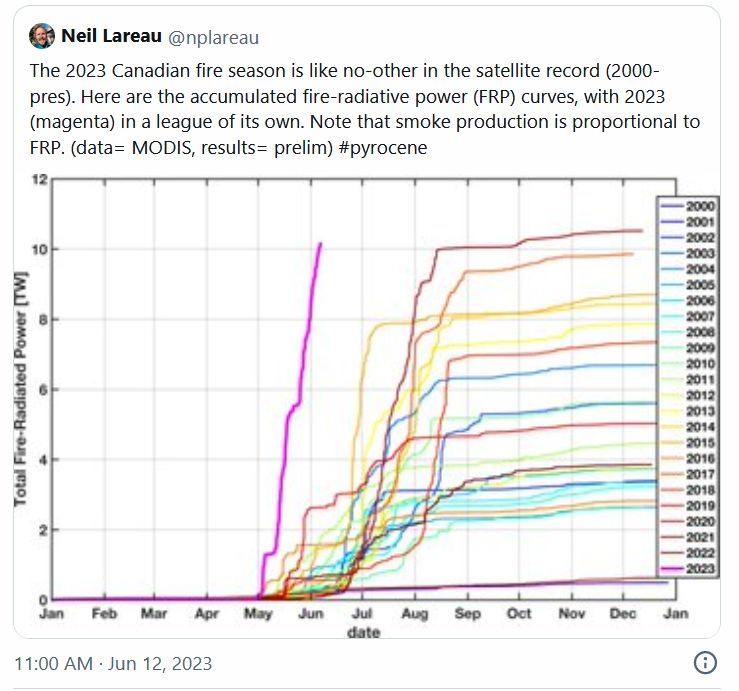
I didn’t expect the PhD in aerosol science to come in quite so handy for everyday life, but knowing a lot about tiny particles (aerosols) has been pretty useful the last few years.
The chart below is fantastic, but let me interpret a bit.
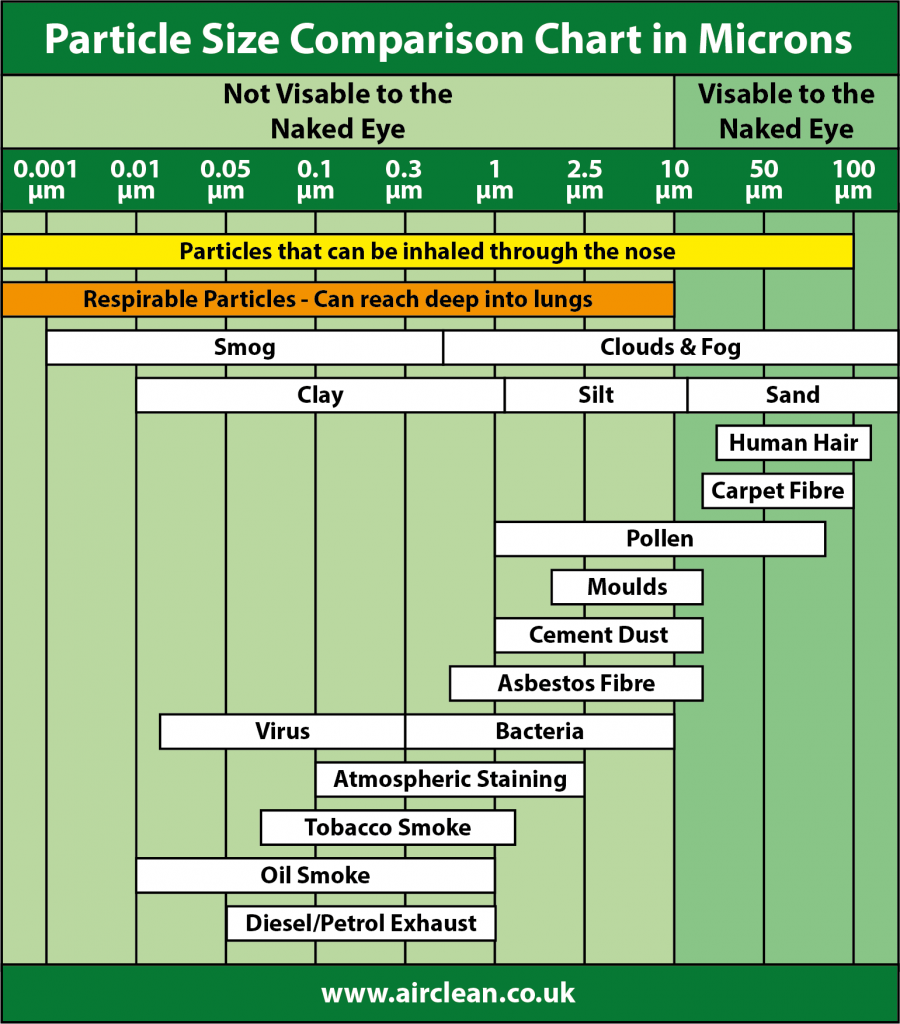
Aerosols are tiny particles (liquid or solid) that are so small they generally stay aloft for long periods of time (unlike, say, rain drops or dust, that fall to the ground pretty quickly).
Important things to know:
- aerosol size range is huge, from sub-micron to 100 microns*
- there’s a lot of them
- the small ones are the most dangerous
PM10 (aerosols bigger than 10 microns*). Aerosols you can SEE are basically MASSIVE (10-100 microns). They might annoy you (if you’re allergic) but they’re not hazardous (unless they’re made of dangerous chemicals), mostly because your body has ways of clearing them out: coughing, sneezing, etc. Mostly we don’t worry about PM10.
PM2.5 (aerosols smaller than 2.5 microns). YOU CANNOT SEE THESE. Yet they are still here to mess you up. These aerosols are more dangerous because when you breathe that stuff in, it STAYS. Your body does not have effective ways of clearing it out. Some particles in this range are relatively harmless (dust, fog) but some are bad (mold, pollen), and anything submicron (below one micron) is the literal worst. These get deep in your lungs, you can’t cough them out, and some even cross over into the bloodstream (and the smallest ones can cross the blood-brain barrier to really hurt you). These tiny aerosols are so bad because they’re super small, super numerous, and super nasty (viruses, combustion products, benzenes, every manner of volatile organic compound).
Smoke is basically a petrochemical aerosol soup of submicron particles. The only thing worse than smoke (from any kind of combustion, but especially wildfires because who knows what is burning) is actual chemical plant fires (or you know, derailed trains carrying polyvinyl chloride set on fire). Those will kill you dead right away.
The rest just go deep in your lungs and find ways to feed noxious chemicals throughout your body for life.
So that’s fun!
(Even more fun: Smoke that stays around long enough will eventually cook in the UV light and turn into chemical fumes anyway.)
UPSHOT: when you see me (on social media) freaking out and deploying air purifiers and chastising everyone I know to TAKE PRECAUTIONS, close the windows, wear a mask, do whatever you can to keep the smoke out of your lungs… now you know why.
(I’m sorry — I have this knowledge, and now you must too.)
* micron = μm = micrometer = one millionth of a meter (Width of a human hair ~50 microns)
FUN FACT: when they’re measuring PM2.5, they’re really measuring aerosols between ~one and two microns and using that as a proxy for all the submicron particles, which are very hard to measure and there are just zillions of them. So there’s WAY MORE than any of the measurements are actually telling you. Yay!
How to Protect Yourself From the Smoke
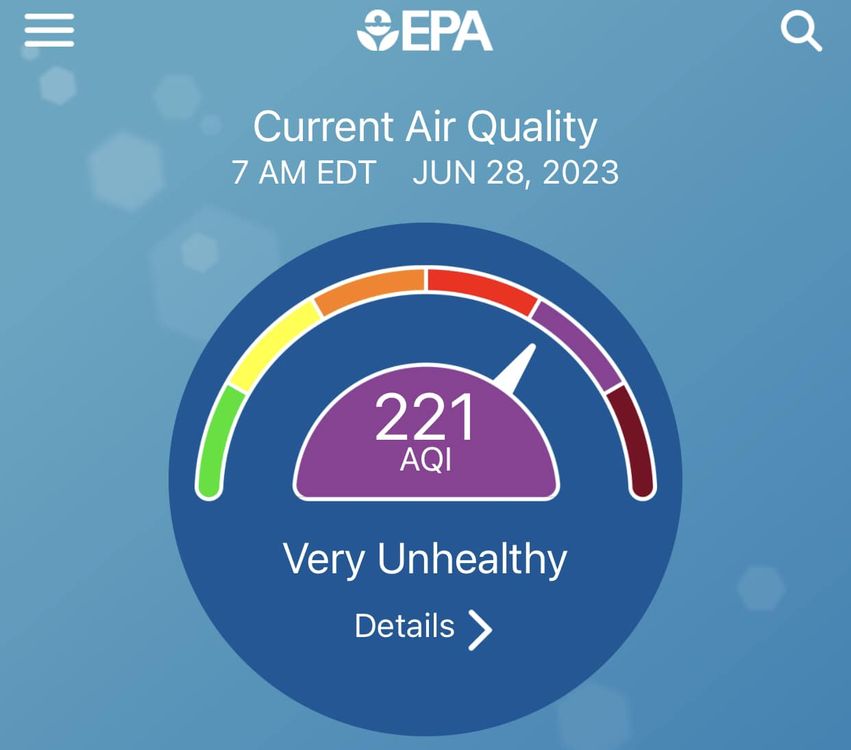
Download the EPA’s AirNow app and monitor it like you would the weather.
The standard advice is to stay inside if you’re “sensitive”, but I hope you understand now that just staying inside is nowhere near enough to protect your lungs and the lungs of those you love.
Keeping the windows closed is not enough, okay? You’ve got to run the air purifiers/HEPA filters. Because that smoke is going to get into your house at a steady rate. (All houses have a natural exchange rate of air that allows “fresh air” — or in this case, smoky hazardous air — into your house at a steady rate).
If you don’t have a particle detector, you may not realize how much smoke is actually in the house. If you can smell it, it’s definitely bad. But it’s bad at concentrations lower than what you can smell.
- Stay inside whenever possible
- Turn your “central air” system on “fan only” to filter particles with your furnace filter
- Turn on individual room air purifiers
- If you’re driving in your car in a smoke event, change your cabin air filter or use a personal air purifier (or wear a mask)
- If you have to go outside, wear a mask (N95).
More on all that below.
Upgrade Your Equipment Now
Has the smoke event passed? Don’t worry, it will be back! Now is the time to prepare for the next one.
AIR PURIFIERS
For individual rooms: I like this air purifier because it has UVC to kill viruses as well as filtration for smoke.
For LARGE rooms (think: living rooms): I like this air purifier because on the high mode it clears out a big room fast, plus it has a particle counter so you can use it as a monitor as well.
(UPDATE 2025: I’ve found another cheaper purifier with a “relative” (good-moderate-poor) particle counter that also has a smoke filter)
ETA: A Corsi-Rosenthal box (furnace filters taped to a box fan) can be an effective alternative, especially if you have one leftover from the pandemic! (see comments for details).
For your whole-house fan: I recommend the highest rating HEPA filter (or MERV rating) you can get. Last winter, I upgraded my furnace filter from MERV 10 to MERV 13 to clear out allergens for my kid coming home to visit (which was very effective, in addition to the room air purifiers and other measures I took). When the smoke hits, you’ll want to turn on your furnace fan to run continuously, even when the air conditioner isn’t needed for cooling (you should have a “fan only” mode) — the filter only works if you’re pulling air through it and all houses are “leaky” to some extent and the smoke will continuously work its way in and need to be filtered out of the air.
In your car: Since I can still smell the smoke inside my car, even with recirculation on, I tracked down how the air is filtered. There’s a cabin air filter in my 2018 Chevy Volt, but you have to remove the *entire* glovebox to get to it. Plus there’s no indication about the quality level of the filtration. It’s cheaper than going in to the Jiffy Lube guys to change the cabin air filter (and definitely easier and more known filtration level) to deploy a mini air purifier in the car and recirculate. This personal air purifier was about 1.5x the cost of the car air filter and you can take it anywhere. Your car might have an air filter that’s easier to access.
When the smoke hits, I run all of these (at least until my particle counter says I’m back down to normal ranges indoors again).
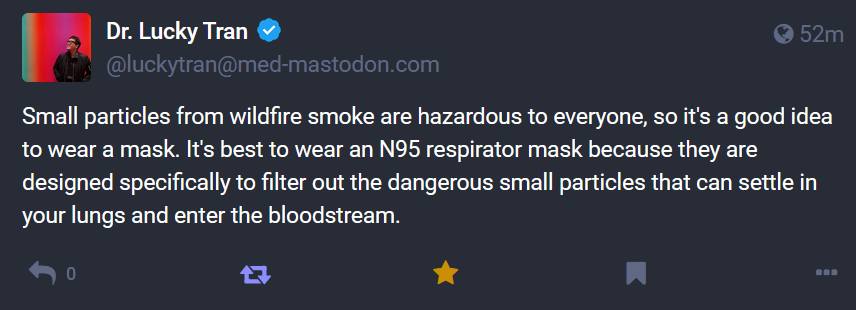
And if you HAVE to be outside, for the love of your lungs, wear an N95. Otherwise, you’re volunteering all that terrible stuff into your lungs.
Adam McKay (DON’T LOOK UP) called this smoke thing a “mass inhalation event” and that’s what I’m calling it from now on.
About that Air Conditioner…
This is my periodic reminder that if you need a new air conditioner, I highly recommend you get a heat pump instead (does both heating/cooling) — heat pumps qualify for the 30% tax rebate under the Inflation Reduction Act passed last year and switching to electricity for heating (as well as cooling) pushes the energy transition forward.
If your AC is running just fine… and it’s old… and you haven’t had it checked/maintained in a while… that’s a good thing to do now. It’s much better (and generally cheaper and more comfortable) to replace the AC before it dies.
Broadly speaking, AC units last about 15 years, but you’ll often need “recharging” (a refill) of coolant before then. But the wrinkle to that is that the older coolants were SUPER bad for the environment and they’ve been phased out. So your AC may work *okay* and just need a recharge on coolant, but the coolant may be phased out, and thus super expensive to replace (if you can even get it).
You can often get free assessments on your AC, either through an HVAC company or your local utility (they may offer free home energy audits, which might include an assessment of your AC unit).
Last summer, I knew my AC was getting old — I paid $75 for a “maintenance check” from a local HVAC company (before I turned it on for the summer). They said it basically needed to be replaced. Which I fully planned to do… but before I got to it, we had a heat wave, I turned it on… and it not only blew out, it fried my furnace motor as well.  I ended up with a new motor and a new heat pump installed on top of my gas furnace — if it gets cold enough that the heat pump struggles, it automatically switches over to gas. This winter, I only had to use the gas for a couple days, during an extraordinary cold snap. So if you’re looking for that reassurance during super cold weather, having a gas backup can give you that.
To me, it’s worth the cost of the maintenance check to get a good assessment.
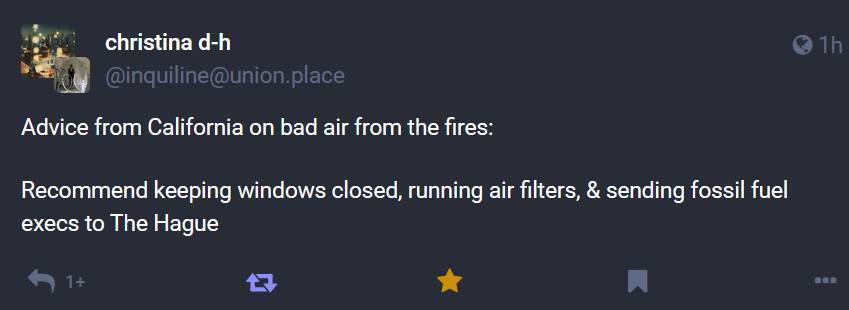
Additional Thoughts
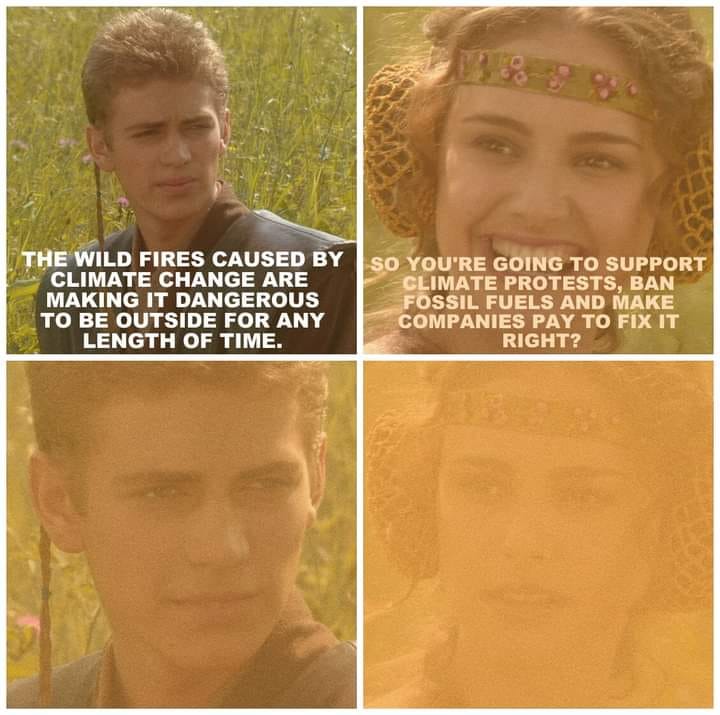
I keep thinking of all the people who would be better protected from wildfire smoke right now if we’d installed better filtration systems for COVID.
The environmental impact gap will widen in the years to come.
And not just the Global South suffering from the effects of a climate crisis they did not cause.
Before, disparities environmental impact were about who got access to clean water and clean air — who was too poor (or Black or brown) to keep the chemical companies out of their neighborhood, and who was white and wealthy enough to keep nuclear plants (and wind farms) out of their backyards.
Going forward, the gap will be between those with information and those who are ignorant of the dangers. Those who can afford to move away from the hurricane zone and those who can’t get air conditioning when the heat dome hits. Those who can afford an air purifier and those unwilling to wear masks.
The gap won’t be only between rich and poor but between those whose ideologies and mindset allow them to adapt and those who believe only “the weak” wear a mask, watch the air quality monitors, and get the vax for the latest viral outbreak.
Bad air quality makes me super sensitive to people doing smoky things in the smoke.
- Like the neighbors cutting down A TREE to feed it into a gas-powered machine that chops it to bits and spits out more smoke.
- Like the lawn maintenance guys next door running their gas-powered riding lawnmowers, no masks. I can’t think of anything more symbolic of the entire problem than the affluent having lawn maintenance that uses gas — lots of extra gas because they’re riding lawnmowers so they have to carry a human around as well as cut the grass — to cut a lawn that is itself a blight on the ecosystem. In the middle of record unhealthy smoky air from climate-driven wildfires. Without masks.
- Like the first day of a return to moderate air quality — not even a return to “normal” just not heinously deadly — and my neighbors down the street have a MASSIVE BONFIRE in their backyard. Like they took all the extra lumber from a small house, piled it in the back and set it ablaze. Literally flames a dozen feet high.
Somehow I’m nearly slayed by second-hand irony and yet the neighbors don’t feel a thing.
It’s not just frustrating; it’s a sign of who is adapting and who is going to suffer climate health effects that will mystify them. Be the people who adapt and keep your loved ones healthy.
NOWHERE IS SAFE
I’m hearing a lot from people that either 1) they don’t think climate change will affect them personally or 2) they think they’re at risk but they’re “dreaming about moving to Buffalo NY or Canada”.
I personally live in a near-Goldilocks-Zone* for climate in Pittsburgh — we’re not on the coast, we have plenty of water, we’re not at risk of fire (more than normal), we don’t get super cell tornados, we’re insulated from Hurricanes, everything is on a hill so flooding rarely happens.
The worst I thought we’d get was Polar Vortexes taking out the power and freezing us. Or maybe a heat dome that does the same. But I’m personally protected even from that with my solar panels and battery backups.
I did not have “smoke from Canada” on my Climate Impact Bingo Card.
NOWHERE IS SAFE.
*Not counting pollution — pollution is everywhere, it’s just worse some places and we think those are the “polluted” places but it.is.everywhere.
I’m not trying to terrify everyone, but I’m hoping that this will (eventually?) translate into the necessary sense of alarm and “we need to change the way we do things.”
And not just more of this:
- Stage 1: Deny the Problem Exists
- Stage 2: Deny We’re the Cause
- Stage 3: Deny It’s a Problem
- Stage 4: Deny We can Solve It
- Stage 5: It’s too Late
We can be smarter than this. We can adapt. We can make smoke mitigation (and whatever other adaptations are coming down the pike) part of our standard day, deploying as necessary and then returning to our normal, everyday lives.
I hope y’all find this information helpful!
Stay safe, friends.
Sue
MORE RESOURCES: if you’re looking for local resources for masks to keep safe outside, check out this website for helpful links.
CR boxes are generally the cheapest and most effective. Should be #1 recommendation of an air purifier.
There’s tons of different versions for everyone’s needs- including using PC fans so they are quieter, or tiny ones for cars.
Corsi-Rosenthal boxes are definitely an effective option, especially if you already have one lying around from the pandemic!
Link for info (for those who aren’t familiar): https://en.wikipedia.org/wiki/Corsi%E2%80%93Rosenthal_Box
It’s a little misleading to say they’re the cheapest and most effective air purifier options.
CR boxes became very popular early in the pandemic, once people figured out the virus was airborne. Suddenly, everyone wanted an air purifier and they were instantly sold out everywhere. So CR boxes became popular not because they were *cheaper* or *better* but because they were *available*. You could DIY one together quickly. Whether you actually *needed* one in the pandemic really depended on your situation. There was a lot of confusion early on about the virus, how it was spread, etc. If you were quarantined inside your house like a lot of folks, you didn’t really need an air purifier — the virus had to come from *someone* and if you didn’t have people bringing the virus into the house, the air purifier wasn’t doing much for you. OTOH if you did have someone in the house who had the virus, sequestering them in a room and using a CR box to clean the air could potentially keep it from spreading to everyone else — so it was a great thing to have on hand, in case that happened. Further testing showed that these boxes were indeed effective at trapping COVID-sized aerosols, so that’s good. And likely those aerosols, once trapped, would be desiccated by the airflow and thus killed. But that wasn’t a guarantee. And any filter has the danger of collecting up stuff and *growing* it. This is why I recommend the room air purifier with the UVC light which is guaranteed to kill the virus, making sure you’re not growing anything on your filter and inadvertently spreading it. But, for the most part, CR boxes are effective for COVID, especially in a pinch (which is what a lot of folks experienced in the pandemic).
As for cost, again, it was popular because it was *available*. The cost of a box fan and 4 HEPA filters is not small. Home Depot shows a range of prices for filters, and the higher MERV rated ones are more expensive — let’s say $25 apiece. The box fan is another $25. So the CR box will run around $125 (and then replacement filters will be another $100 each time you have to replace). The room air purifier I recommend is $99 with replacement filters $20 — and that includes UVC and carbon filtration. The large-room air purifier I recommend is $249 with replacement filters $50. So the cost of a CR box is more than the small air purifier and about the same as the large one, once you have to replace the filters one time. And I would say both of the air purifiers I recommend have better features than the CR box, ie they’re more effective.
Now, if you already have a CR box laying around from the pandemic and you have a single smoke incident, it’s fast, easy and zero-cost to deploy, so you should definitely use it. But you should make sure you’ve got the high-quality filters and consider the cost for how much it would be to replace those filters vs. buying an air purifier, if you’re going to be using it on an ongoing basis.
But thank you for the reminder to include this option!
This link has a bunch more information on CR boxes including how to add a carbon filter, which you’ll want if you’re getting repeated smoke events that last for a significant time, as the VOCs in the air can get cooked by UV and turn into some nasty byproducts. A CR box won’t filter those, but if you add a carbon pad, they can. The air purifiers I recommend already have a carbon filter layer in them.
https://www.texairfilters.com/another-variation-on-the-corsi-rosenthal-box-air-cleaner-permanent-frames/
Thank you. My PhD is in art history, sooooo, not super helpful in this instance!
We each have something to bring — I’m glad we have art historians in the world as well!
Thanks for posting this!
You are most welcome!
Yes! A huge mitigation technology bit of knowledge which isn’t getting enough circulation stares us all in the face every time we look in the mirror: Ground level glass mirrors, pointing at the sun! Harvard’s Dr. Ye Tao and team have produced what I think are revolutionary assessments about how affordable, durable, and effective mirrors can be for immediately cooling our overheating Earth! Their proposed “MEER:ReflEction framework” delves deeoly into all aspects of the science behind how we can save the planet. Learn more by searching youtube for “MEER”, or visiting http://www.meer.org !
I’m generally leery of large-scale attempts to geo-engineer our way out of climate change. We’re not smart enough to understand the side-effects, and this often is used as a distraction, letting us continue “Business as Normal” (carbon emissions) because we’re going to geo-engineer our way out of the problem. I think that’s a serious mistake.
However, I’m 100% on board with mitigations that are helping people survive the terrible heat, especially in urban areas, that’s already here (and going to get worse). So from that perspective, painting rooftops white or installing mirrored roofs in places that cannot afford air conditioning or have any other access to cooling will 100% save lives and we should support that. But that’s a mitigation to save lives not a strategy to solve the overall climate problem.
Thank you for sharing your knowledge with us! It is so important that everybody realize what you talk about in your article and take it seriously.
National Geographic ran an article recently also. There are links to good masks and information on the Corsi-Rosenthal air filter.
Excellent! One silver lining to all the smoke and heat is that various news services are reporting on climate risks more regularly. I highly recommend subscribing to Grist, an award-winning environmental journalism organization, for fantastic reporting as we head deeper into the Anthropocene.