Not Just the Hero’s Journey But With a Girl
Since I first discovered Gail Carriger’s Heroine’s Journey in 2020, I’ve written exclusively Heroine’s-Journey-structured stories… I can’t promise I’ll never write another Hero’s-Journey-structured novel, but given that I’ve pretty thoroughly found a genre-home in hopepunk (and climate fiction), and my penname writes romance (which is all Heroine’s Journey), I don’t really see a lot of “heroic” fiction in my future.
Read on to see why this has transformed the way I write. And why it’s an integral part of writing hopepunk.
From October 5, 2020:
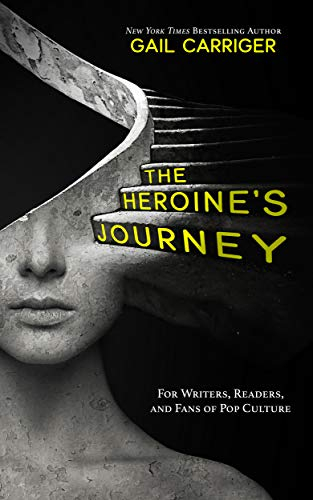
The Heroine’s Journey: For Writers, Readers, and Fans of Pop Culture
Multiple New York Times bestselling author Gail Carriger presents a clear concise analysis of the heroine’s journey, how it differs from the hero’s journey, and how you can use it to improve your writing and your life.
First, it’s rare to have an author of Carriger’s stature write a book about craft. Second, while the Hero’s Journey has an endless procession of accolades, classes, books, workshops (I’ve taken one) analyzing the “classic” steps of the Hero’s Journey for decades (Star Wars was explicitly based on Joseph Campbell’s claim that this story structure was fundamental to all stories, forever), I’d only seen a couple attempts at describing/analyzing a Heroine’s Journey, and they both fell flat for me as a storyteller.
THIS BOOK IS THE TREATMENT I’VE BEEN WAITING FOR.
I immediately dropped everything I was doing and read this cover-to-cover, highlighting half the book.
It was a revelation.
And it arrived at the perfect time for editing my audacious, hopepunk-as-hell, and definitely Heroine’s Journey novel.
A Brief Tutorial
| HERO’s JOURNEY: Protagonist voluntarily isolates from society, defeats bad guy, gets the MacGuffin, returns for glory and honor. HEROINE’s JOURNEY: Protagonist forced away from society, family/community is broken, she gathers friends and information to fix the rift, they gain victory together. (Whether you’re a reader or writer, I highly recommend the book to understand our society-wide biases about storytelling—this is, in fact, very much why I’m writing hopepunk. More on that in a moment.) The difference between the Journeys is immediately obvious, yes? The Heroine is focused on fixing what’s broken with the family/community, together with her friends, often building society and making civilization possible along the way, while the Hero is focused on dominating the bad guy and saving the day. Not every story falls neatly into this structure, of course, and when you have groups or multiple POVs, you can even have a mix of heroines and heroes in a story, which makes for very interesting conflict. But these two storylines resonate because they are foundational—and we’ve only been talking about one of them. |
| IMPORTANT NOTE #1 Heroes can be male/female/non-binary. Same for Heroines. Wonder Woman is a Hero. Harry Potter is a Heroine. The Journeys should be labeled Warrior/Peacekeeper or Adventurer/Healer but they’re not because we’re still steeped in a world that thinks only the male-patterned stories are the “important” ones. |

| IMPORTANT NOTE #2 Heroine stories outsell Hero stories by a wide margin. All romances are Heroine stories and they comprise half of all novels sold (and half the money in the industry). Harry Potter and Twilight—two of the largest selling franchises ever—are Heroine stories. So while the “Hero” story gets all the workshops and attention, studied and revered, Heroine stories are out there making all the money and considered “less than” by academics and the public alike. Hm. Almost like there’s a massive societal bias against female-coded stories… wait, I’ve almost got it… ah, yes, my old friend, patriarchy! |
But Sue, I thought you were writing hopepunk?
I am.
Hopepunk is themes, characters, philosophy, and an aesthetic.
Heroine’s Journey is plot… and to some extent characters.
The two complement each other in a structural sense, but more importantly, hopepunk is all about community and healing, radical compassion, we’re all in this together. Heroine’s Journey is all about fixing what’s broken in families and community.
Choosing hope is the radical act of a heroine.
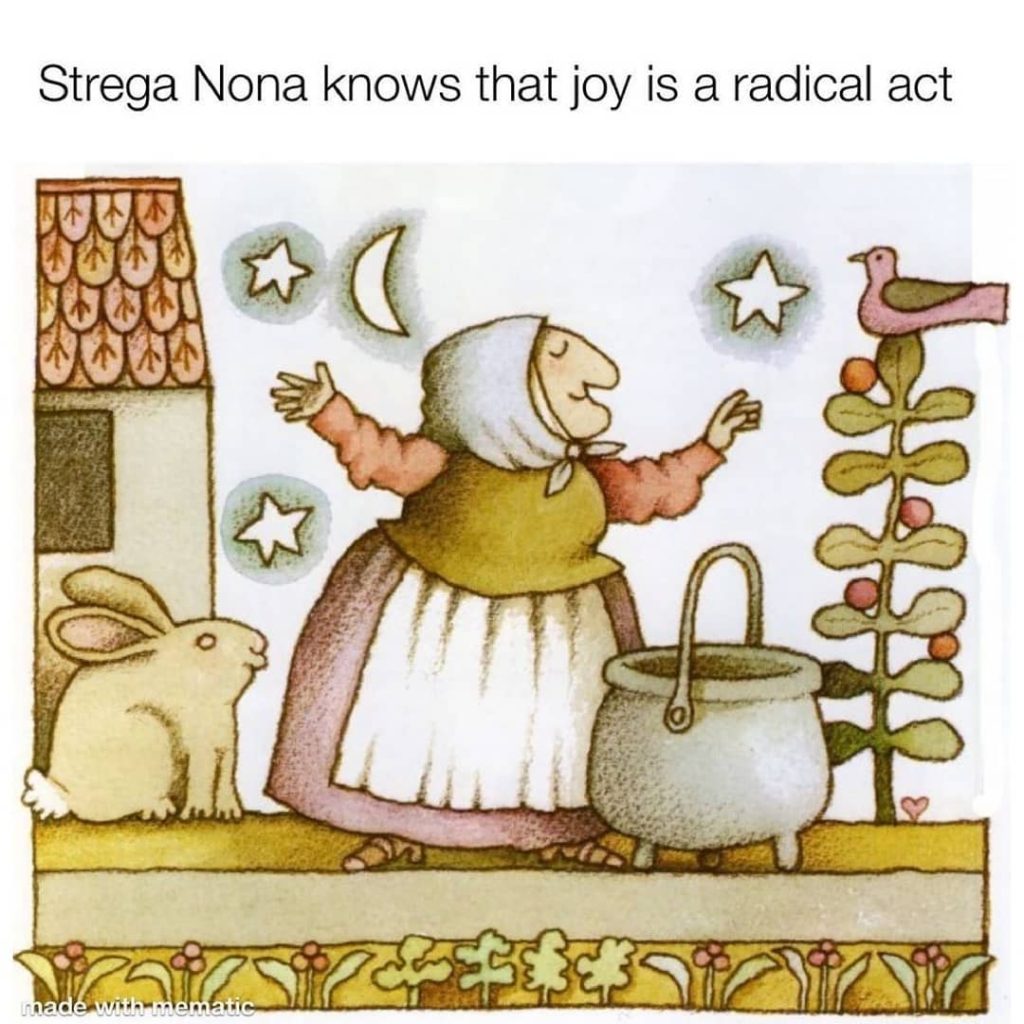
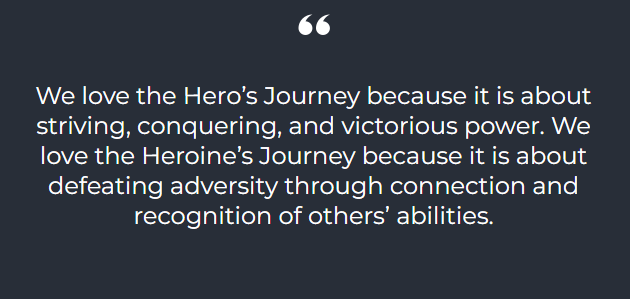
Without realizing it, I’ve been writing both Hero and Heroine stories. Most of my SciFi stories are Hero stories, although I’ve always had strong Heroine characters and plotlines within them. All of my romances are Heroine stories, although often she’s rescuing a Hero from his own story and bringing him back into civilization. Just like discovering I’ve been writing hopepunk for years before I knew what it was called, this framework of the Heroine’s Journey feels like finally having a name for what I’ve been creating all along… and getting an assist from a fellow-author as I strive to create in this shiny new hopepunk genre.
Just like Heroines do.
It is a different kind of storytelling. It’s a different Journey altogether.
Stay safe, stay well, and don’t lose hope amidst the craziness of the world… we’ll get through this together. It’s what Heroines do.
Sue

Yeah!! Back when I was deciding about applying to grad school in psychology, I learned about Shelley Taylor’s work on how women are likely to respond differently to stressful situations than men (stereotypically) do. We’ve all heard of fight-or-flight, right? But there are so many situations where you can’t flee, and maybe you’re no good at fighting, even verbally, or you can tell that it’s just not the wise thing to do. So how do you deal with stress? Taylor’s theory is that you “tend and befriend.” You use that stress energy to take care of others, and you form connections with others who are probably also stressed, so that you’re not alone. I think that’s very much the path of the Heroine’s Journey.
https://en.wikipedia.org/wiki/Tend_and_befriend
Yes! The fact that “fight-or-flight” is widely known but “tend and befriend” isn’t… just one more testimony to how male-pov-centric science often is (and still is). Whole swaths of humanity have been left out of the theorizing that happens in science… something we’re only beginning to change. We need a lot more of that.
Working on it… 🙂